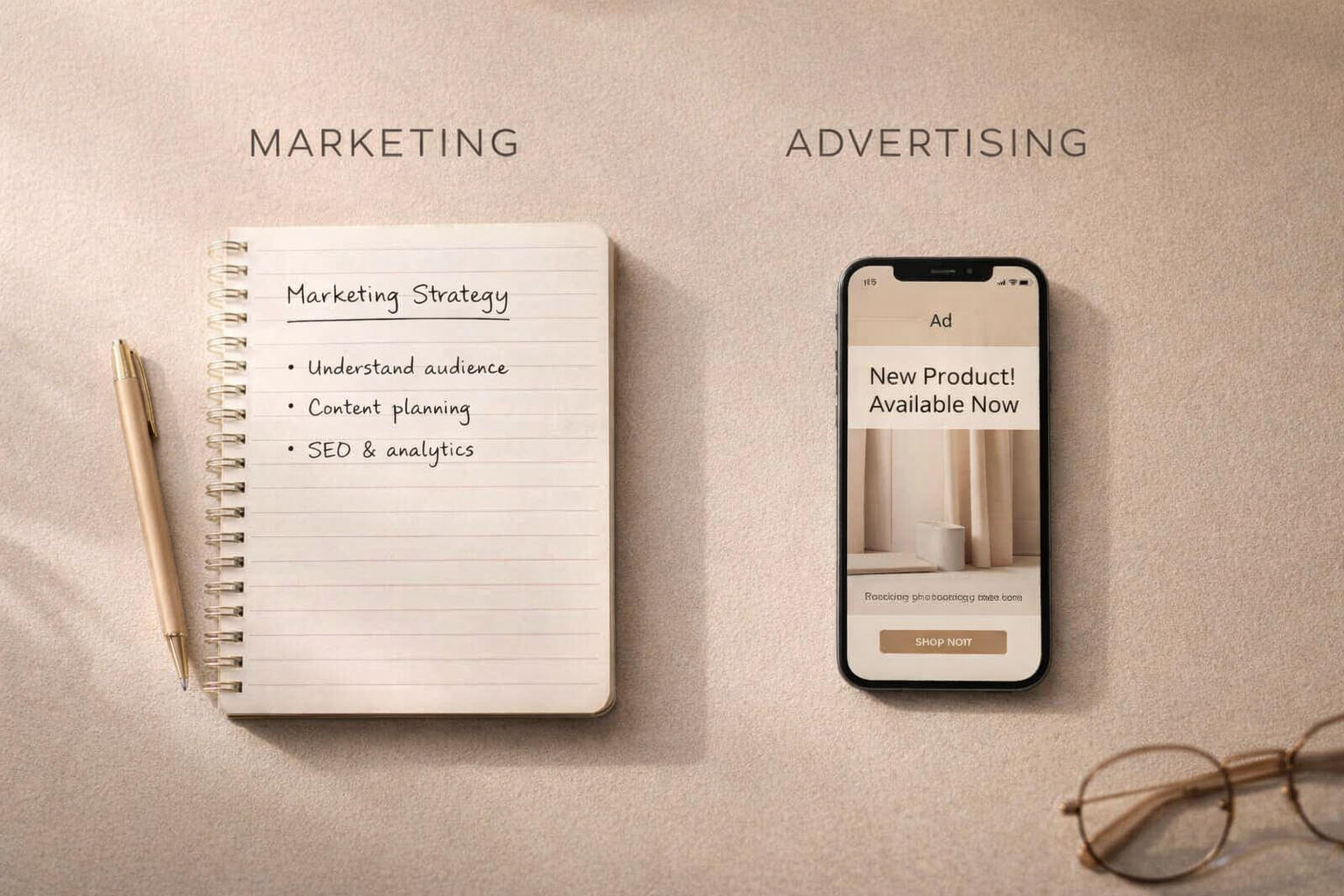
Most people use these words interchangeably. But marketing and advertising are two different things — and confusing them could be costing your business more than you realize.
Here’s a question worth sitting with: do you know the difference between marketing and advertising? If your answer is ‘aren’t they the same thing?’ — you’re not alone. Most small business owners, founders, content creators, and side hustlers use these two words as if they mean the same thing. But they don’t. And that confusion is quietly shaping — and limiting — how you grow your business.
In this post, we’re going to clear it up completely. You’ll understand exactly what marketing is, what advertising is, how the two relate to each other, and — most importantly — how to use both strategically so your business grows with intention, not guesswork.
| 📌 Marketing is the strategy. Advertising is one of the tactics. Knowing the difference changes everything about how you invest your time, your money, and your energy. |
What Is the Difference Between Marketing and Advertising?
Let’s start with clean definitions, because this is where most of the confusion begins. Marketing is the overall strategy and process of identifying your audience, understanding what they need, and communicating why your product or service is the right solution. It encompasses everything from your brand positioning and content strategy to your customer experience and pricing decisions.
Advertising, on the other hand, is a specific tactic within your marketing strategy. It refers to paid promotional messages designed to reach a defined audience and drive a specific action — a click, a purchase, a sign-up. In other words, advertising is something you buy. Marketing is something you build.
Think of it this way: marketing is the umbrella, and advertising is one of the tools that lives under it. You can have a marketing strategy without advertising. But you can’t have effective advertising without a marketing strategy underneath it.
| 💡 You can run ads without a marketing strategy — but you’ll waste money. Marketing without advertising can still build a business. The two work best when they work together. |
Marketing vs Advertising: A Side-by-Side Comparison
To make this even clearer, here’s a direct comparison of the two across the dimensions that matter most for your business:
| Aspect | 📣 Marketing | 💰 Advertising |
| Definition | Overall strategy to attract & retain customers | Paid promotion to reach a specific audience |
| Scope | Broad — covers all channels and touchpoints | Narrow — one paid channel or campaign |
| Cost | Time and effort (often low direct cost) | Money — you pay to place the message |
| Examples | SEO, content, email, social, brand strategy | Facebook ads, Google ads, sponsored posts |
| Timeline | Long-term — builds over time | Short-term — runs while you’re paying |
| Goal | Build awareness, trust, and relationships | Drive a specific action — click, buy, sign up |
| Owned/Paid | Mostly owned and earned channels | Paid channels only |
| Without the other | Can work — slower but sustainable | Risky — spends money without strategy |
What Marketing Actually Includes
Now that we’ve established the difference, let’s dig into what marketing actually looks like in practice. Marketing is far broader than most people realize. In fact, it includes every activity designed to understand, attract, convert, and retain your ideal customer. Here’s what that covers:
Brand Strategy
Before you create a single post or run a single ad, your brand strategy defines who you are, who you serve, and what makes you worth choosing. This includes your positioning, your messaging, your visual identity, and your brand voice. In other words, brand strategy is the foundation that all other marketing sits on.
Content Marketing
Content marketing is the practice of creating valuable, relevant content — blog posts, videos, podcasts, social media — that attracts your ideal customer without interrupting them. Unlike advertising, content marketing builds trust over time. As a result, it tends to have a longer lifespan and a compounding return on investment.
Email Marketing
As we’ve covered in previous posts, email marketing is one of the highest-ROI channels in any marketing strategy. It lets you communicate directly with people who have opted in to hear from you — no algorithm, no ad spend required. Furthermore, it converts at a significantly higher rate than social media or paid advertising alone.
Social Media Marketing
Organic social media is a marketing activity — not an advertising one. When you post content on Instagram, LinkedIn, or Pinterest without paying to promote it, you’re doing marketing. You’re building an audience, creating visibility, and cultivating relationships. That said, social media can also become a channel for advertising when you pay to boost or promote content.
Search Engine Optimization (SEO)
SEO is the practice of optimizing your content so that it ranks higher in search engine results — driving organic traffic to your website without paying for each click. It’s one of the most powerful long-term marketing strategies available, because a well-optimized blog post can drive traffic for years after it’s published.
| 📌 Marketing is what builds your brand, your audience, and your trust over time. It works while you sleep — especially when SEO and email are part of the mix. |
What Advertising Actually Is
Advertising is a subset of marketing — specifically, it’s the paid promotion of your product, service, or brand to a defined audience. Unlike organic marketing activities, advertising requires a budget. However, when done strategically and backed by a strong marketing foundation, advertising can significantly accelerate your results.
Paid Social Media Ads
Platforms like Facebook, Instagram, TikTok, and Pinterest all offer paid advertising options that let you reach audiences beyond your existing followers. These ads can be highly targeted by demographics, interests, and behaviors. Consequently, they’re particularly effective for reaching new audiences who match your ideal customer profile.
Search Advertising (PPC)
Pay-per-click advertising — most commonly Google Ads — places your business at the top of search results for specific keywords. You pay each time someone clicks. For example, if someone searches ‘branding agency near me,’ a well-placed Google Ad can put your business at the top of the results page immediately, without waiting for organic SEO to kick in.
Sponsored Content and Influencer Advertising
Sponsored posts, paid partnerships, and influencer collaborations are all forms of advertising. You pay someone — a creator, a publication, or a platform — to promote your brand to their audience. When executed well, this form of advertising feels more native and less disruptive than traditional display ads.
Traditional Advertising
Television, radio, print, and outdoor advertising are all traditional advertising formats. While these channels are less commonly used by small businesses due to cost, they can still be effective for certain audiences and markets. Most importantly, the same principle applies: advertising works best when it amplifies a clear, well-defined marketing message.
Why the Difference Between Marketing and Advertising Matters
Understanding this distinction isn’t just academic — it has real implications for how you allocate your time, your budget, and your energy as a business owner. Here’s why it matters:
It Prevents Expensive Mistakes
Many small businesses spend money on advertising before they have a clear marketing strategy in place. Without a defined audience, a compelling offer, and a brand people trust, advertising is just paying to interrupt strangers. As a result, you burn through budget without getting the return you expected — and conclude that ‘ads don’t work.’
It Helps You Prioritize at Every Stage
If you’re just starting out, investing in marketing — content, SEO, social media, email — almost always delivers better long-term ROI than jumping straight into paid advertising. On the other hand, once your marketing foundation is solid and you have a proven offer, advertising can amplify what’s already working and accelerate growth significantly.
It Clarifies Your Budget Decisions
When you understand that marketing and advertising are separate investments, you can budget for both deliberately. Marketing investments — a website, a brand strategy, a content calendar — are largely upfront investments that pay off over time. Advertising spend is ongoing and requires continuous monitoring and optimization. Therefore, knowing the difference helps you plan more accurately.
How to Use Marketing and Advertising Together
The most effective business growth strategies combine both. Here’s a simple framework for thinking about how they work together at different stages:
Stage 1 — Build Your Marketing Foundation First
Before you spend a dollar on advertising, make sure your marketing foundation is solid. This means having a clear brand identity, a defined target audience, a website that converts, and at least one strong content channel working for you. Without this foundation, your advertising will underperform — because there’s nowhere compelling to send people.
Stage 2 — Use Marketing to Identify What Works
Your organic marketing — social media, content, email — is essentially a free testing ground. Pay attention to what resonates. Which posts get the most saves? Which emails get the most clicks? Which topics drive the most traffic? These signals tell you exactly what your audience wants — and that insight is invaluable before you start paying to promote content.
Stage 3 — Use Advertising to Amplify What’s Working
Once you know what resonates, advertising becomes a multiplier. Instead of guessing what to promote, you’re putting budget behind content and offers that already have proven organic traction. Consequently, your advertising dollars go further — and your results are more predictable.
Stage 4 — Measure Both Sides
Finally, track results across both channels separately. For marketing, monitor traffic, engagement, email list growth, and organic conversions. For advertising, track click-through rate, cost per click, cost per acquisition, and return on ad spend. Together, these metrics give you the full picture of your growth engine.
| ⚠️ Don’t advertise your way out of a marketing problem. Fix the strategy first — then use advertising to scale what’s working. |
The Bottom Line: Marketing vs Advertising
To summarize: marketing is the overall strategy and process of attracting, converting, and retaining your ideal customer. Advertising is a paid tactic within that strategy. One builds your brand over time. The other amplifies it in the short term. Both are valuable — but neither works well without the other.
If you’re a small business owner or founder just getting started, prioritize your marketing foundation first. Build your brand, define your audience, create content, grow your email list. Then, when you have a proven offer and a clear message, use advertising to accelerate.
Ultimately, the businesses that grow the fastest aren’t the ones with the biggest ad budgets. They’re the ones with the clearest strategy — and the discipline to build both the long game and the short game simultaneously.
| READY TO BUILD A STRATEGY THAT USES BOTH? Let’s Build Your Marketing and Brand Strategy Together At Annulysse Branding we help entrepreneurs, small business owners, and creators build the complete picture — brand strategy, content marketing, and paid advertising — all working together to grow your business. ✅ Brand strategy that attracts your ideal customer ✅ Marketing systems that build long-term trust ✅ Advertising strategy that converts when you’re ready to scale → Let’s Talk at annulyssebranding.com Because the right strategy combines both — intentionally. |
Marketing is the broad strategy of identifying your audience, understanding their needs, and communicating why your product or service is the right solution. Advertising is a specific tactic within marketing — it’s the paid promotion of your message to a defined audience. In short: marketing is the strategy, and advertising is one of the tools within it.
Yes — and for most small businesses, this is the right starting point. Organic marketing channels like content marketing, SEO, email marketing, and social media can build a sustainable audience and drive real revenue without any paid advertising. In fact, building your marketing foundation first typically delivers better long-term ROI than jumping straight into paid ads
It can be both. When you post organic content on Instagram, LinkedIn, or Pinterest without paying to promote it, that’s marketing. When you pay to boost a post or run a paid campaign on those platforms, that’s advertising. The key distinction is whether you’re paying to place or amplify the message.
Marketing first. Before you spend money on advertising, you need a clear brand identity, a defined target audience, a website that converts, and at least one content channel generating organic traction. Without this foundation, advertising spend is largely wasted — because there’s nothing compelling for people to land on once they click.
A common guideline is to allocate 5 to 10 percent of your revenue to marketing and advertising combined — with the split between the two depending on your stage of growth. Early-stage businesses should invest more in organic marketing. As your revenue grows and your offer is proven, gradually shift more budget toward advertising to accelerate what’s already working.